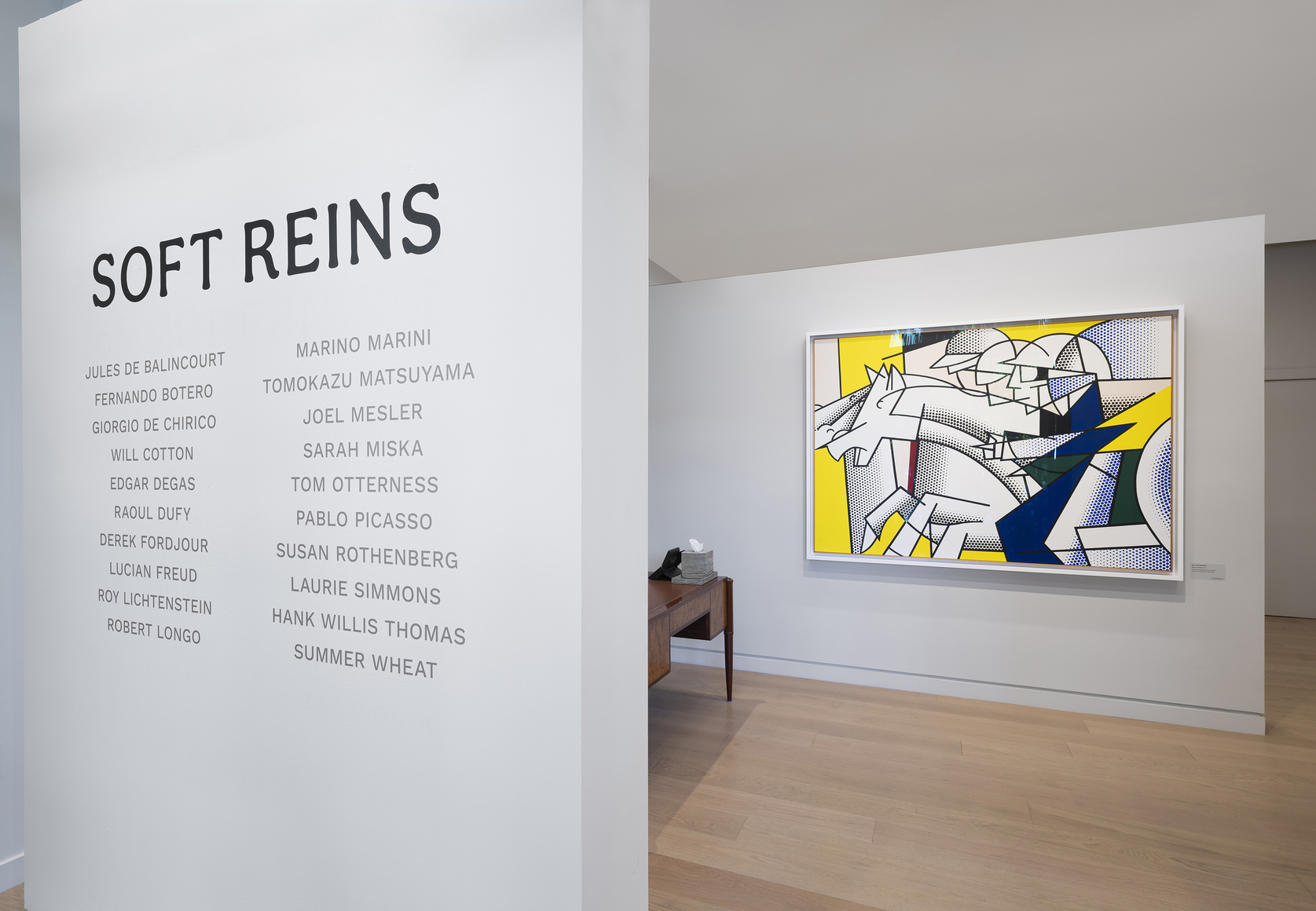
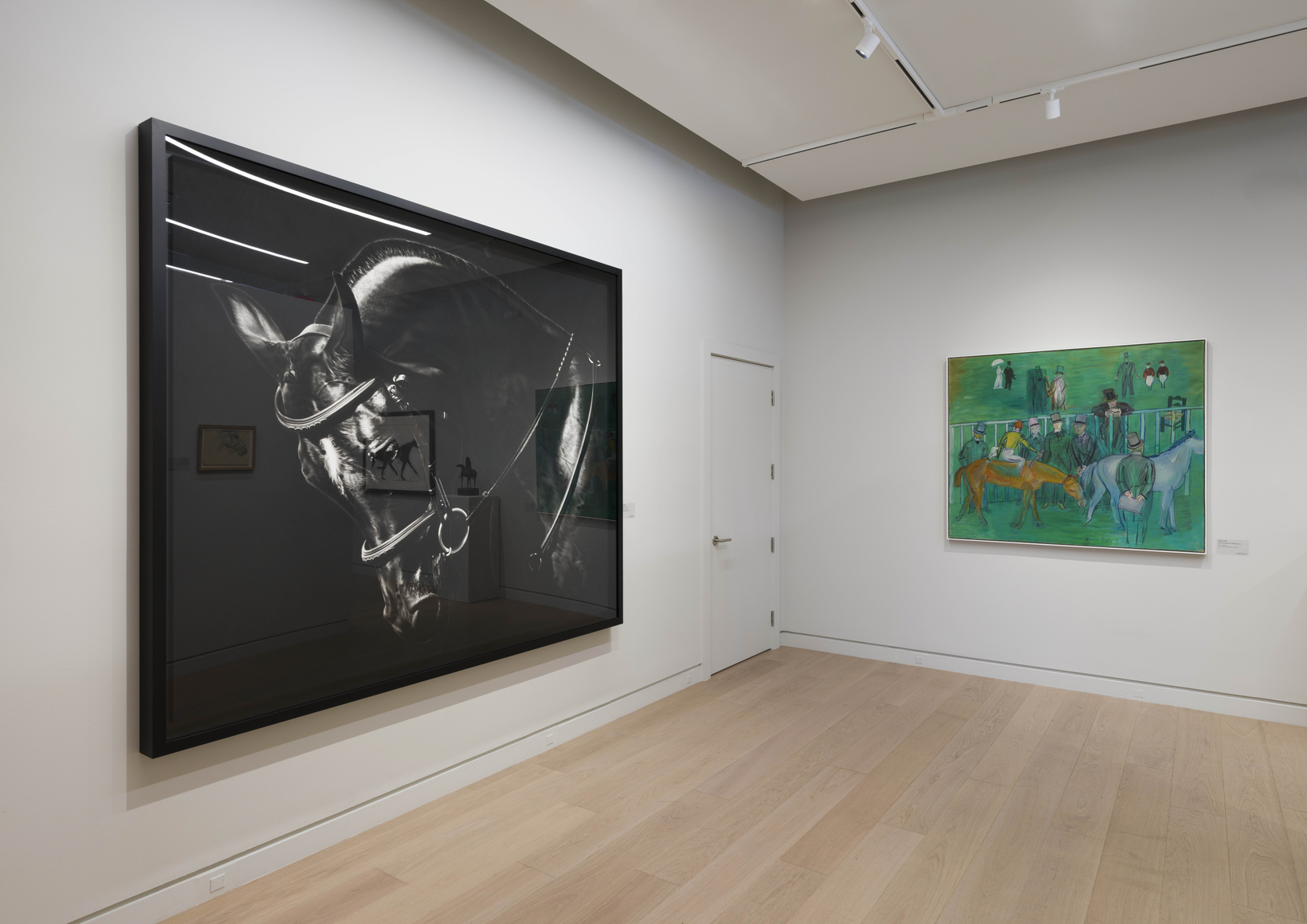
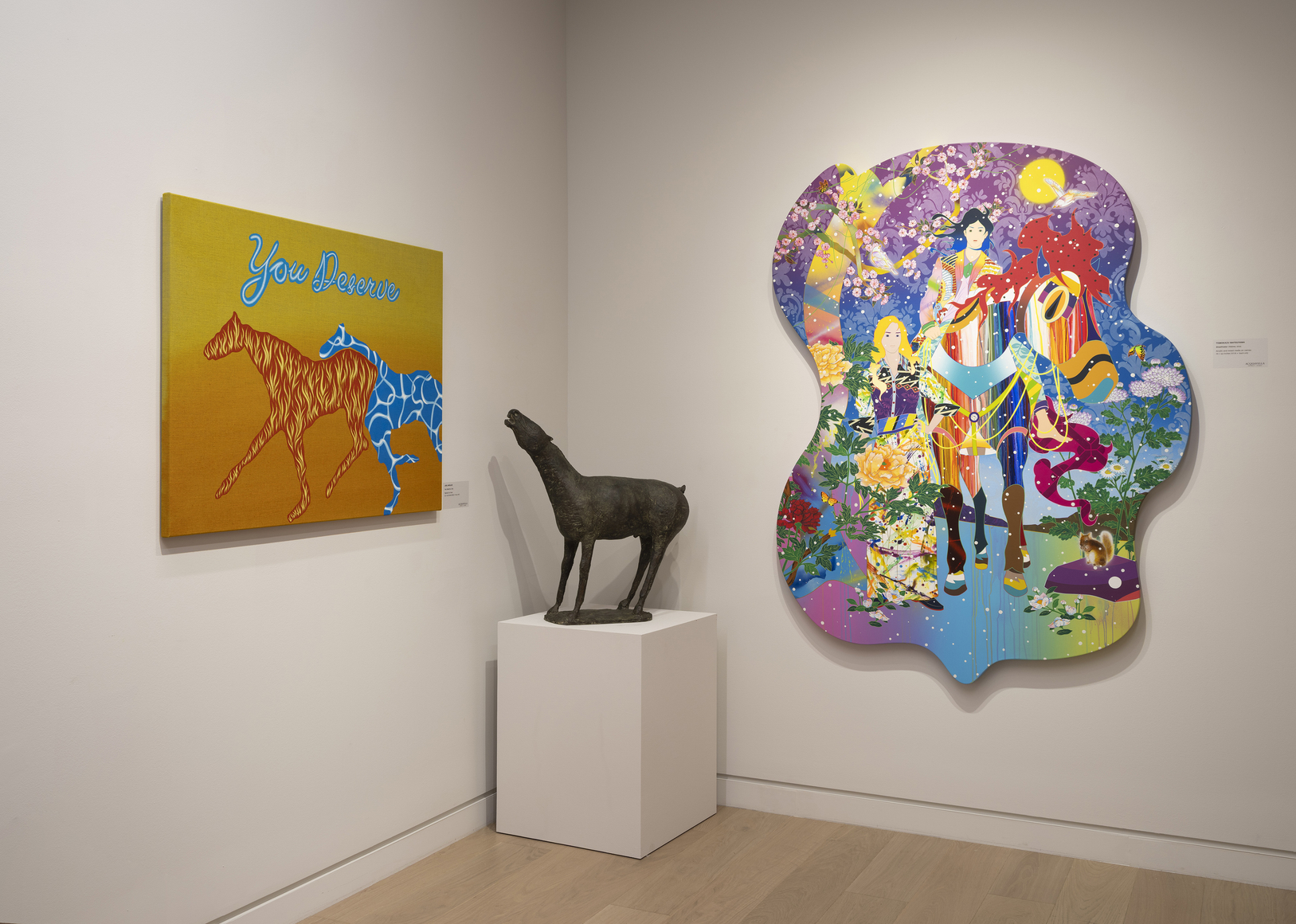
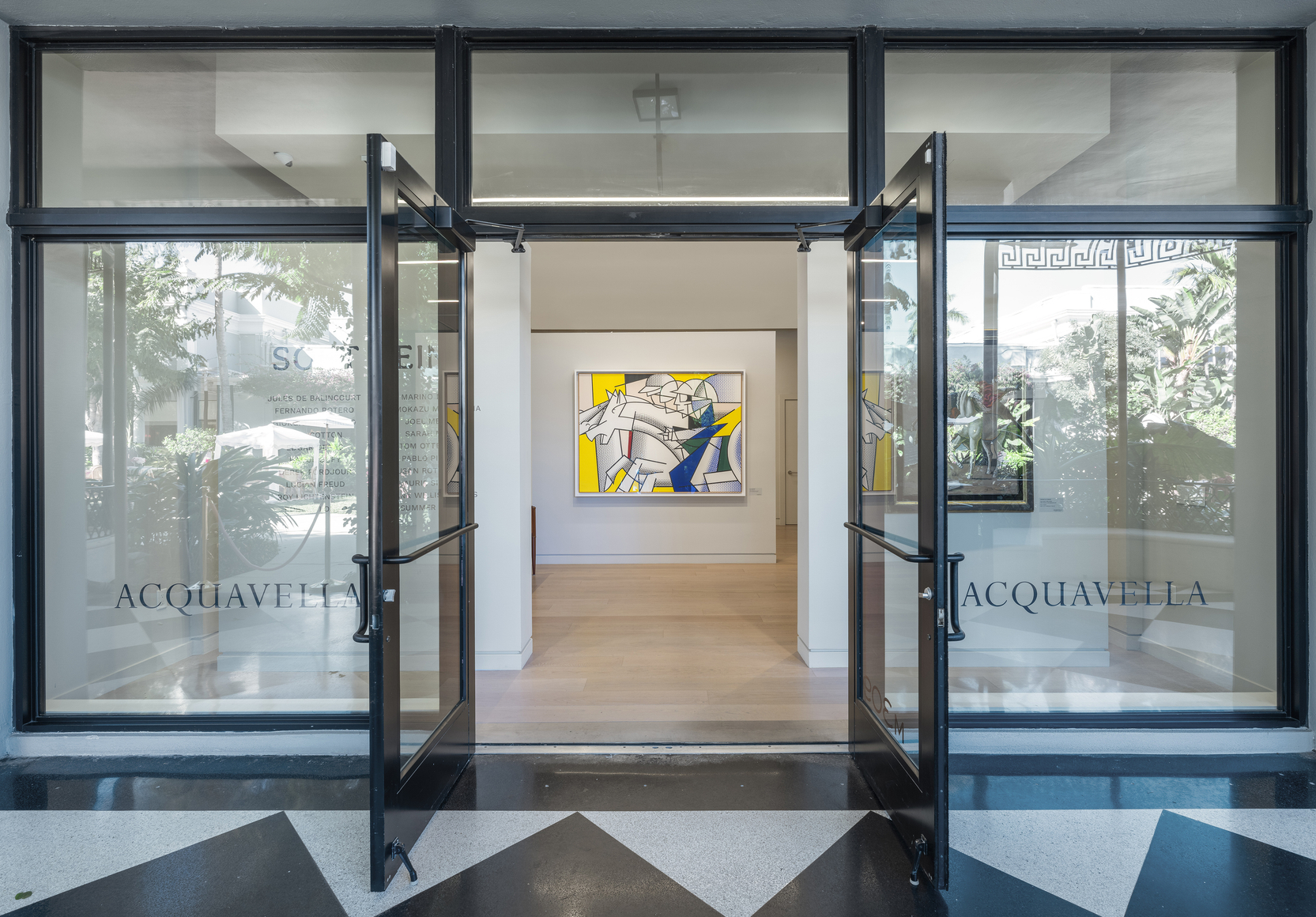
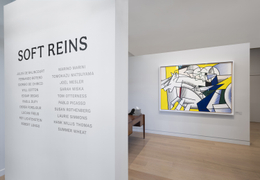
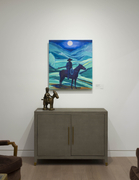
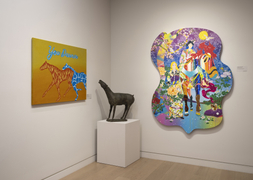
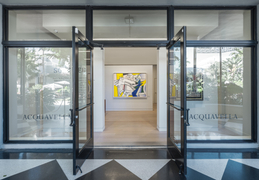
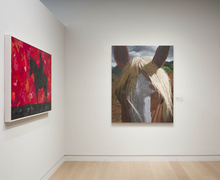
Acquavella Galleries is pleased to present Soft Reins, a group exhibition exploring the enduring significance of the horse as a powerful symbol and artistic muse, highlighting how the animal has inspired art, mythology, and storytelling throughout art history. Guest curated by the artist Tomokazu Matsuyama, Soft Reins will be on view at Acquavella’s Palm Beach gallery from February 6 through March 22, 2026. An opening reception and panel discussion will also be held at the gallery on the evening of February 6th.
The title Soft Reins refers to a dynamic between a horse and its rider: when drawing gently on the reins, the horse responds naturally and without resistance. This intuitive ability and connection between horse and rider mirrors the dynamic between the artist and muse, presenting the horse as an enigmatic source of inspiration across cultures and histories. By presenting a diverse array of artists and media, Soft Reins underscores the horse's lasting impact on the artistic imagination. It highlights its capacity to convey profound messages across distinct cultures and eras, making it a dynamic subject for ever-changing times.
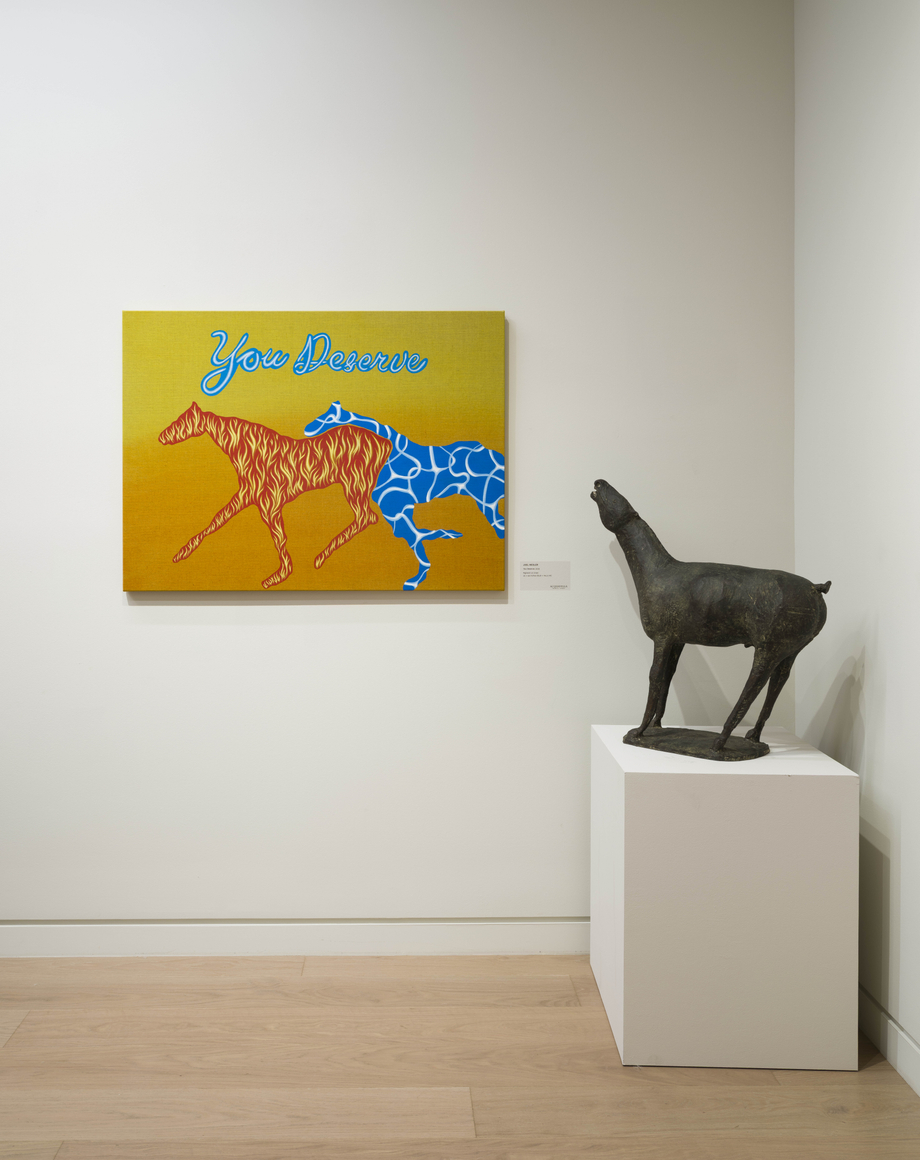
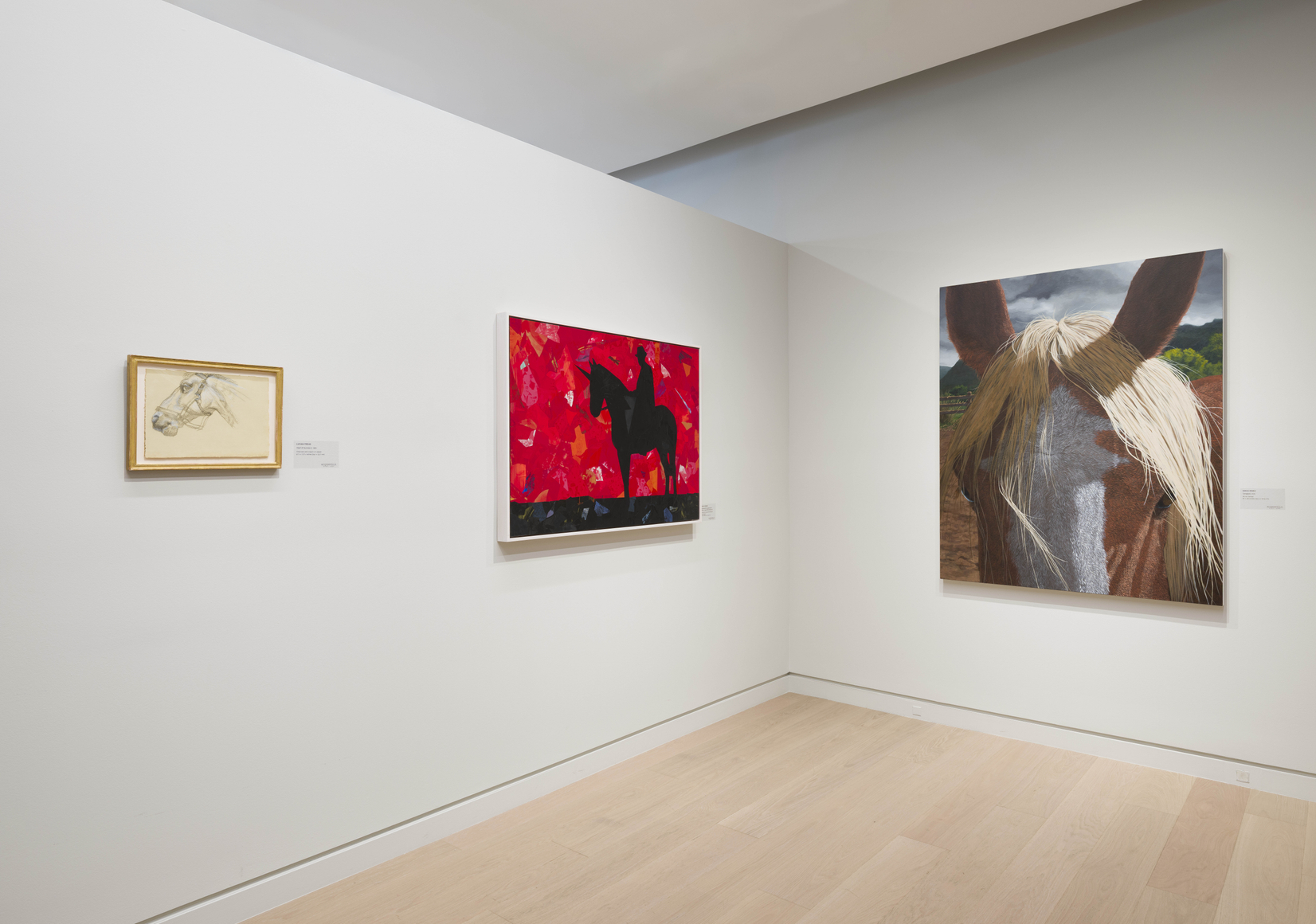
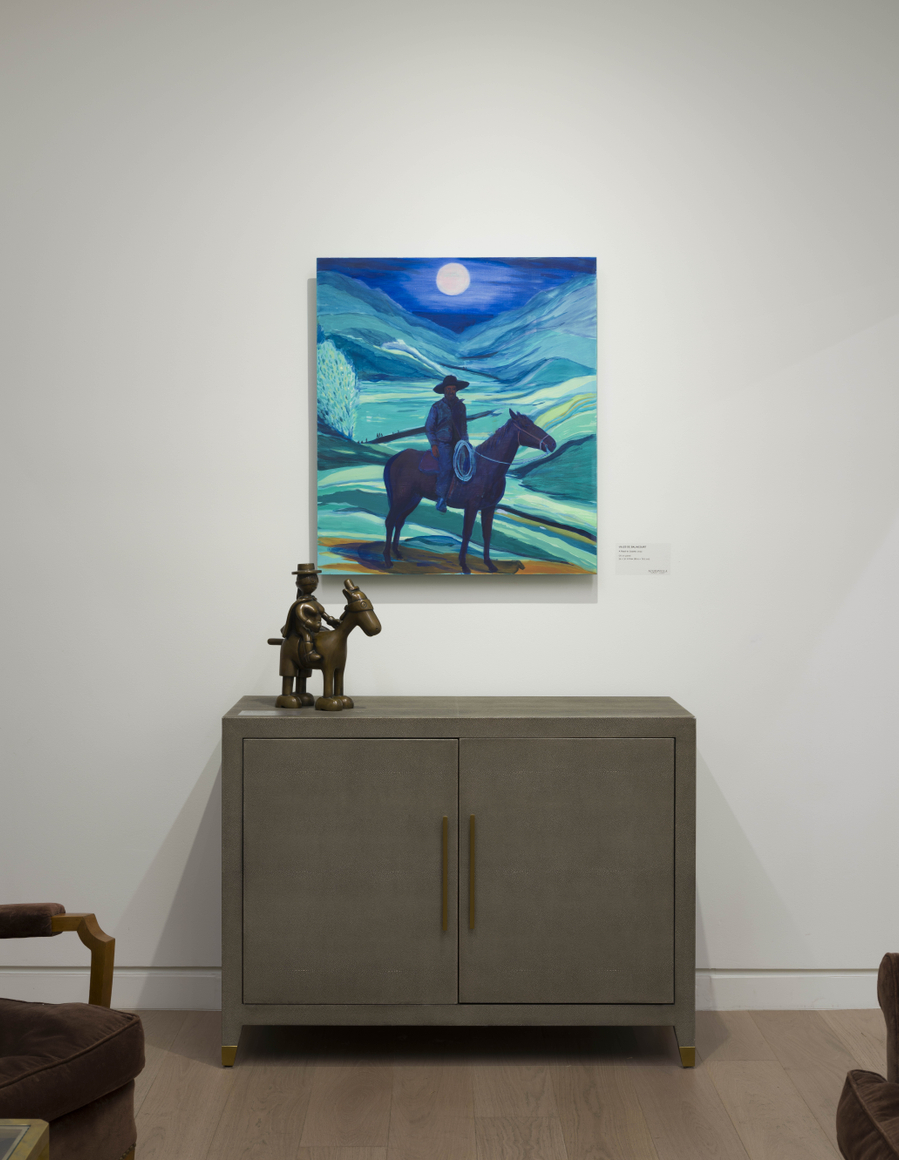
The exhibition brings together an expansive dialogue of artists, from Impressionist and modern masters to leading contemporary figures including Jules de Balincourt, Fernando Botero, Will Cotton, Giorgio de Chirico, Edgar Degas, Raoul Dufy, Derek Fordjour, Lucian Freud, Marino Marini, Tomokazu Matsuyama, Joel Mesler, Sarah Miska, Pablo Picasso, Roy Lichtenstein, Robert Longo, Tom Otterness, Susan Rothenberg, Laurie Simmons, Hank Willis Thomas, and Summer Wheat.
As both curator and participating artist, Matsuyama reflects: “Equestrian imagery has long served as a vessel for power, memory, and collective identity. Across cultures—from Western academic painting to Japanese woodblock traditions—the figure of the horse and rider has carried narratives of war, migration, and cultural exchange.
In my own practice, I reinterpret this legacy through layered visual languages, drawing from disparate histories to form compositions that feel both familiar and unbound by a single tradition. Rather than highlighting an individual hero, I am interested in how equestrian forms can symbolize the movement of ideas across time and geography. By weaving together references from different cultures and eras, the work becomes a shared space—an image shaped not by one lineage, but by the many stories that converge within it.”
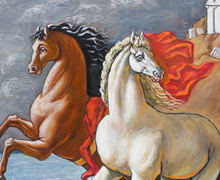
Among the works on view is Giorgio de Chirico’s Due cavalli in Riva al Mare (1970). This painting exemplifies de Chirico’s recurring use of the horse as an ancient and mythic motif. Passionate about revitalizing the language of classicism, de Chirico revisited the horse as a source of inspiration for decades. Here, two horses are gallantly posed along the seashore, with classical ruins scattered across the beach beneath a moody gray sky. A flash of red fabric billows behind, a surreal touch that gestures to the horse in Greek and Roman mythology as a transitional figure between worlds, often symbolizing power and divinity.
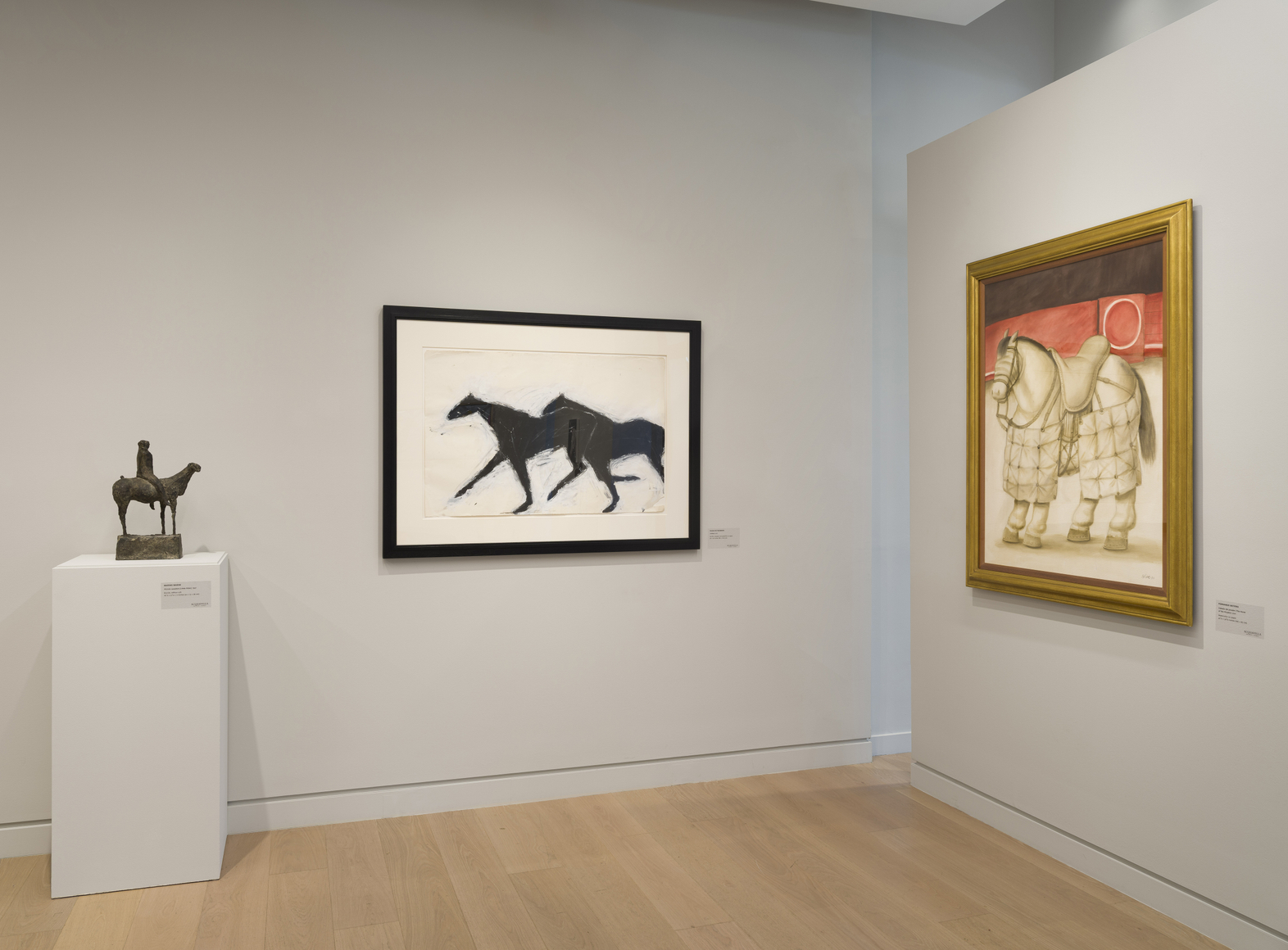
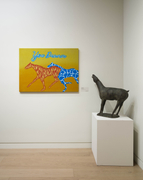
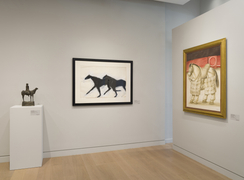
The Colombian painter and sculptor Fernando Botero used the horse as a symbol that aligned with his own tradition and history. His sculpture Uomo a cavallo (1982), as the title suggests, shows a man perched on his horse, presenting the animal as man’s faithful companion and friend. Rendered immaculately in bronze and in his voluminous style, the sculpture is remarkably composed and balanced. For Botero, the horse is a dignified and noble companion, linking his work to a long tradition of Spanish artists, including the equine portraits of Diego Velázquez and Francisco Goya.
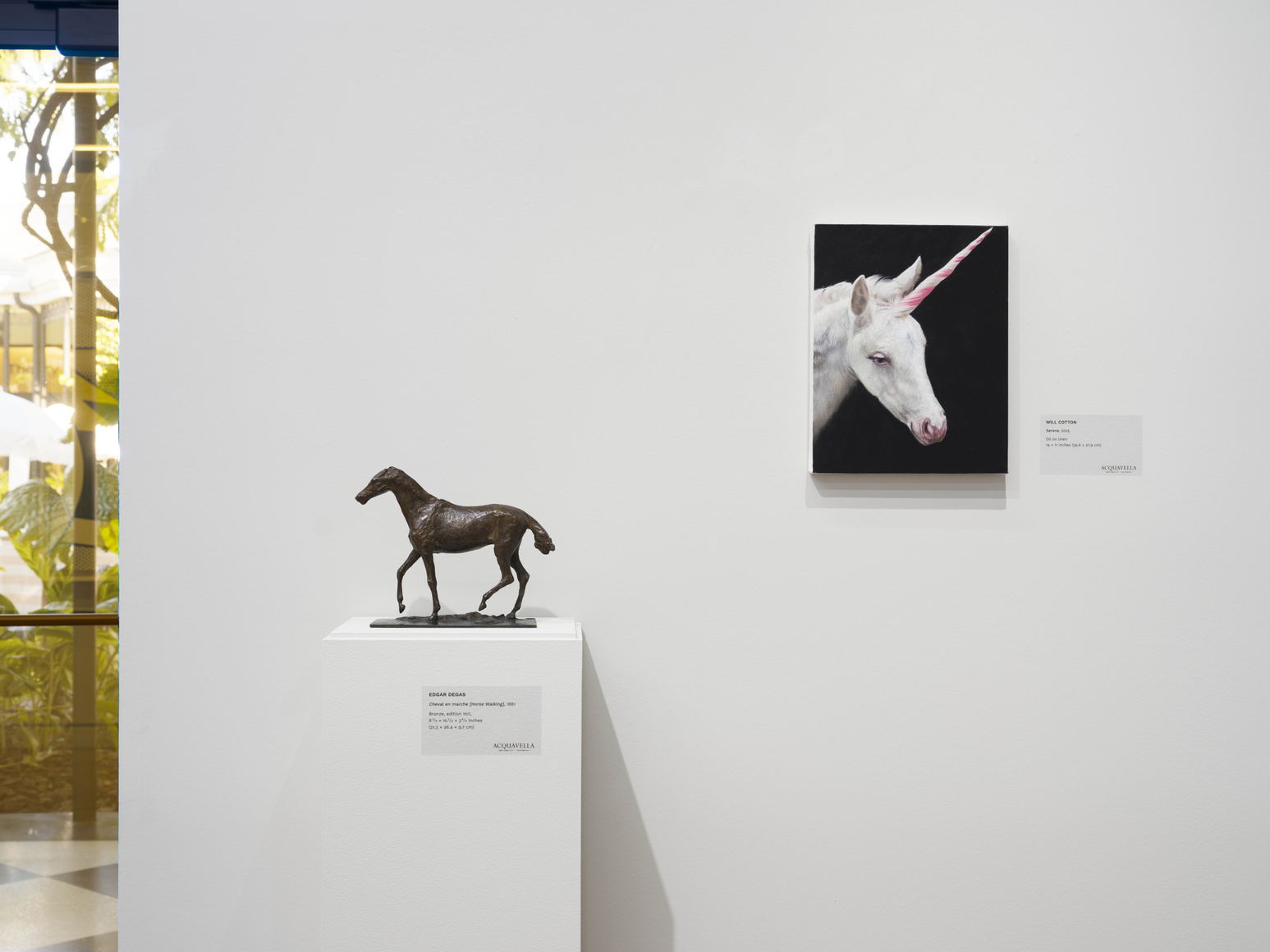
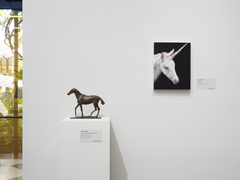
In contrast, Will Cotton nods towards the horse and its place in the American imagination. Often conjuring cinematic images of cowboys or abundant arrays of candy, Cotton’s American tropes point to a culture of dreamlike excess. The unicorn, the supernatural incarnation of the horse, is a regular feature in Cotton’s paintings. In Serene (2025), a glowing white unicorn possesses an otherworldly candy cane horn. Painstakingly lifelike, Cotton creates an image so beautiful and sweet that it becomes unsettling. While some artists use the horse as a muse or myth, others have used it as a formal strategy in their work.
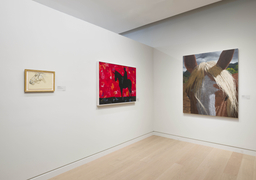
Celebrated for her iconic horse paintings from the 1970s, Susan Rothenberg is included in the exhibition with Untitled (1977), a work on paper depicting two horses in motion, overlaid with black silhouettes. In 1974, just a few years before this work was produced, Rothenberg began painting the horse to experiment with composition, color, line, and form. Although clearly representational, Rothenberg was responding to and butting against theory and practice brought about by Abstract Expressionism, Minimalism, and other post-war movements. For Rothenberg, the horse served as a framework to link the lineages of abstract and representational art, calling upon our collective memories and the primal human urge to represent the world around us.


![Edgar Degas Cheval au galop tournant la tête à droite, les pieds ne touchant pas le sol [Galloping Horse Turning its Head to the Right, its Feet not Touching the Ground], 1881-1890](https://static-assets.artlogic.net/w_2020,h_1160,c_limit/exhibit-e/559650f9cfaf34ff158b4568/ac79129a191197e537fe0028b2d6a8e2.jpeg)


![Edgar Degas Cheval au galop tournant la tête à droite, les pieds ne touchant pas le sol [Galloping Horse Turning its Head to the Right, its Feet not Touching the Ground], 1881-1890](https://static-assets.artlogic.net/w_260,h_180,c_limit/exhibit-e/559650f9cfaf34ff158b4568/ac79129a191197e537fe0028b2d6a8e2.jpeg)