“Matisse: The Pursuit of Harmony” is a stunning gathering of more than 40 paintings, drawings and sculptures from 1900 to 1946. Drawn from major museums and private collections, they span much of the artist’s working life. (Born in 1869, he died in 1954.) The selection includes textbook works such as the bronze reliefs “The Back I-IV” (1908-44) and the five heads of Jeannette, made between 1910 and 1913, here installed, unusually, in a circle so that we see all sides, from different views, in unexpected relationships. We encounter familiar, powerful paintings throughout—among others, the Philadelphia Museum of Art’s remarkable portrait of Yvonne Landsbergwith its aggressively scratched-out arcs; the Phillips Collection’s celebrated interior of Matisse’s Quai Saint Michel studio with its view of the Seine; and the enchanting still life of a cyclamen plant reproduced on the wall of the Museum of Modern Art’s “The Red Studio.”
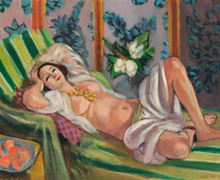
We recognize old friends, particularly among the odalisques and still lifes made after Matisse moved to the south of France in 1917. But there are also rarely seen works from all periods, including the tall, standing “Fatma” (1912) in her embroidered robe, painted during Matisse’s transformative sojourn in Morocco, and the ravishing “La Table Noire (The Black Table)” (1919), its seated model in a green hat, executed with some of the most seductive brushwork in the history of modernism. And much, much more.
As we expect, glorious, unpredictable color dominates. The presence of sculptures underscores the dialogue between two and three dimensions that informs works in all media—the profiles provoked by sculpture that reverberate in the paintings and vice versa. We are reminded that Matisse always affirmed the artifice of painting, presenting us with undisguised models surrounded by studio props, often in garments that repeat from painting to painting. Over and over again, he seduces us with color, engages us with delectable subject matter, and then stuns us with his overwhelming pictorial intelligence and inventiveness. Matisse said he dreamed of an art that exerted “a soothing, calming influence on the mind,” but we leave Acquavella exhilarated.